
Egypt
Heritage Key (Prad Patel)
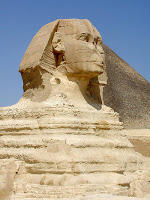 See below for an exerpt from Prad Patel's article (full story on the above link) but I just thought I would mention that in her paper "Ancient Egypt in America" (In Meskell's "Archaeology Under Fire" 1998) Ann Macy Roth says that there is clear textual evidence that the nose of the Sphinx was damaged in 1378 AD "by a religious Muslim who feared that it was the object of improper worship." She cites Haarmann 1980 "(Regional Sentiment in Medieval Islamic Egypt" - Bulletin of the School of Oriental and African Studies 43, p.55-66). Photo courtesy of Jon Bodsworth.
- An Alternative View On The Sphinx
The Daily Grail (Rober Schoch) With 20 comments in response, at the time of posting. I first met the Great Sphinx face-to-face on 17 June 1990. She (yes, I consider the Great Sphinx a female) has influenced and in many ways defined my life ever since....
- Travel: A Trip To Cairo
YOU (Katrina A. Holigores) “You have a beautiful eyes!” No, this was not some grammatically incorrect compliment during a romantic date, but rather an attention-drawing yell thrown at me and a friend as we walked through the Khan El Khalili in Cairo....
- Facts About Ancient Egypt
The Telegraph A bullet pointed list of some facts and almost-facts from ancient Egypt. For example: • Why does the Sphinx have no nose? Legend says Napoleon's army used it as target practice. The truth is it was wrecked 500 years before by Mohammed...
- Travel: Giza Plateau
http://tinyurl.com/y8kayx Short travel piece about the Giza plateau: "The pyramids are home to three Fourth Dynasty Pharaohs , Khufu, Khafre and Menkaure, and are guarded by the equally impressive Sphinx. This guardian sports the body of a lion and the...
- Under The Sphinx
This video is on drilling beneath the sphinx to check the groundwater situation to make sure the monument is safe from deterioration. http://drhawass.com/blog/drilling-under-sphinx...
Egypt
The missing nose of the Sphinx
Heritage Key (Prad Patel)
See below for an exerpt from Prad Patel's article (full story on the above link) but I just thought I would mention that in her paper "Ancient Egypt in America" (In Meskell's "Archaeology Under Fire" 1998) Ann Macy Roth says that there is clear textual evidence that the nose of the Sphinx was damaged in 1378 AD "by a religious Muslim who feared that it was the object of improper worship." She cites Haarmann 1980 "(Regional Sentiment in Medieval Islamic Egypt" - Bulletin of the School of Oriental and African Studies 43, p.55-66). Photo courtesy of Jon Bodsworth.The Great Sphinx of Giza is one of the world's largest and oldest monuments, and isn't without its mystery. Theories fly around regularly about whether there are secret tunnels or hidden halls under the Sphinx, which Dr Zahi Hawass, currently starring in the 'Chasing Mummies' series, insists is not the case in this Heritage Key video (Watch the Video). But my question is much more simple - Whatever happened to the nose of the Great Sphinx?
In a previous Heritage Key article, "Riddle of the Sphinx", Robert Cook wrote about the legend that Napoleon's troops used the Sphinx's nose as target practice during the French invasion of Egypt in 1798. But did they really have such a disregard for thousands of years of history that they purposefully destroyed the nose of the Great Sphinx?
It's a bit of a confusing mystery, mainly because of the poetic license employed by some of those who knew how to draw back in the 18th century. It wasn't so much a case of there being a nose or not, but that the artists felt the Sphinx would be much more attractive and exotic to those viewing the works back in Europe if the monument didn't have a ruined nose. After all, there's not a demand for cats with missing noses in Battersea animal shelter.
- An Alternative View On The Sphinx
The Daily Grail (Rober Schoch) With 20 comments in response, at the time of posting. I first met the Great Sphinx face-to-face on 17 June 1990. She (yes, I consider the Great Sphinx a female) has influenced and in many ways defined my life ever since....
- Travel: A Trip To Cairo
YOU (Katrina A. Holigores) “You have a beautiful eyes!” No, this was not some grammatically incorrect compliment during a romantic date, but rather an attention-drawing yell thrown at me and a friend as we walked through the Khan El Khalili in Cairo....
- Facts About Ancient Egypt
The Telegraph A bullet pointed list of some facts and almost-facts from ancient Egypt. For example: • Why does the Sphinx have no nose? Legend says Napoleon's army used it as target practice. The truth is it was wrecked 500 years before by Mohammed...
- Travel: Giza Plateau
http://tinyurl.com/y8kayx Short travel piece about the Giza plateau: "The pyramids are home to three Fourth Dynasty Pharaohs , Khufu, Khafre and Menkaure, and are guarded by the equally impressive Sphinx. This guardian sports the body of a lion and the...
- Under The Sphinx
This video is on drilling beneath the sphinx to check the groundwater situation to make sure the monument is safe from deterioration. http://drhawass.com/blog/drilling-under-sphinx...